
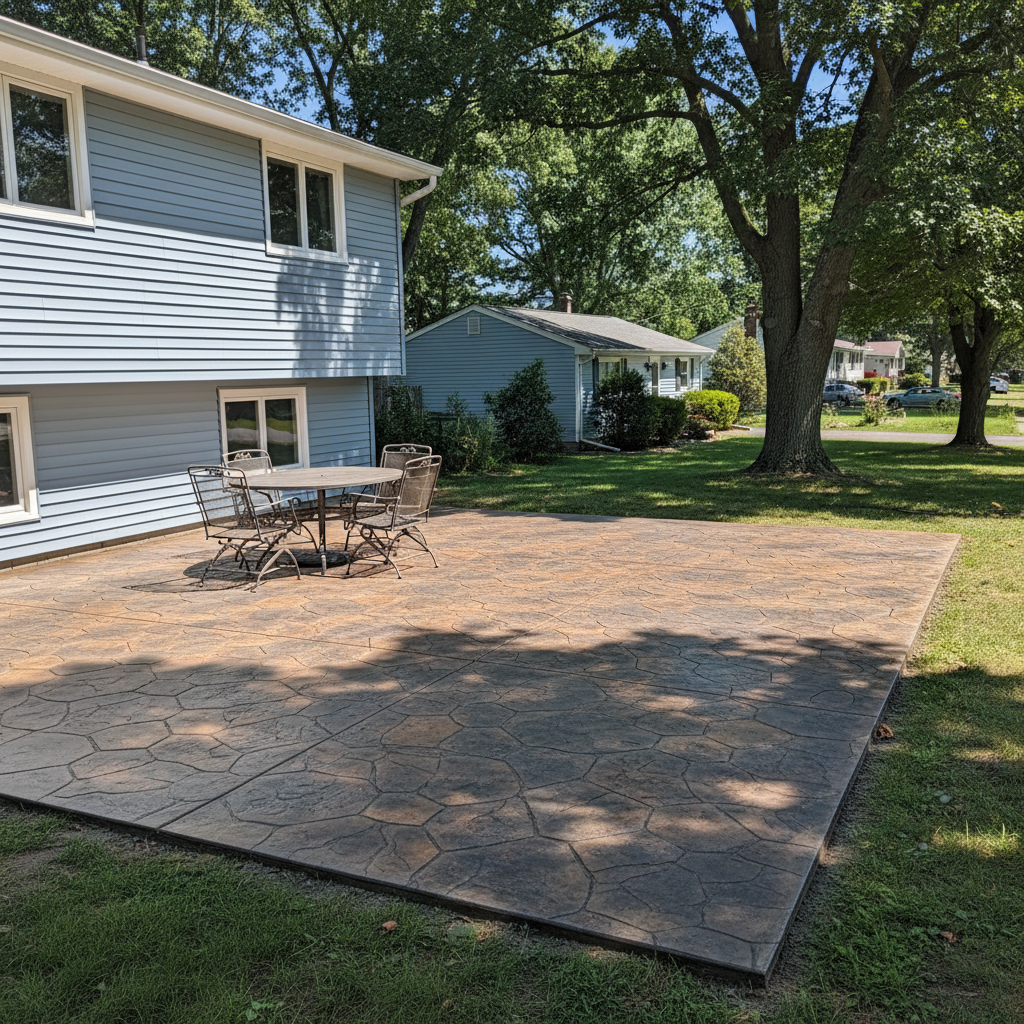
Most people call three contractors, get three numbers that are nowhere near each other, and pick the one in the middle. That's not really a method. Here's what actually separates a contractor who'll leave you with a slab that lasts twenty years from one who'll leave you with a cracked driveway and a lawsuit over a deposit.
Check the license, not just the business card
In New York City, anyone doing home improvement work over a certain dollar amount needs a Home Improvement Contractor license through the city's Department of Consumer and Worker Protection. That's separate from any trade-specific license. Ask for the license number and look it up yourself instead of taking a truck magnet's word for it. A contractor who hesitates to give you that number, or who tells you it's "not necessary for this size job," is telling you something.
Insurance matters just as much. Ask for a certificate of liability insurance and workers' comp, and ask that it name you as a certificate holder. If a worker gets hurt on your property pouring your footing and there's no comp coverage, that bill can land on you.
What the ground under a Bronx lot actually does
This is where a lot of outside contractors get caught out. The Bronx sits on a mix of bedrock and fill, and the two behave completely differently once you start digging footings.
In Riverdale, Kingsbridge, and parts of the North Bronx, you're often hitting Fordham gneiss or Manhattan schist a few feet down, sometimes right at the surface. That's good news for a foundation, bedrock doesn't settle, but it means excavation can mean breaking rock, not just digging dirt, and that changes both the cost and the timeline.
Closer to the Harlem River, the Bronx River, and areas like Hunts Point and Soundview that were built up over old marsh and tidal land, you're dealing with fill, sometimes decades of it, including old demolition rubble from buildings that came down generations ago. Fill settles unevenly. A patio or slab poured without a proper compacted base over that kind of ground will heave and crack within a few years, no matter how good the concrete mix is. A contractor who doesn't ask what's under your yard, or who skips a proper gravel sub-base because it costs less, is setting you up for a callback you'll pay for twice.
Footings for anything structural, a foundation, a retaining wall, need to sit below the frost line, which in this region runs around 36 to 42 inches. Anyone proposing a shallower footing to save a day of digging is cutting a corner that doesn't show up until the first hard freeze two winters later.
Permits aren't optional, and the inspector will know
Structural work, foundations, retaining walls over a certain height, new slabs tied into a building, generally needs a Department of Buildings permit. Sidewalks are different: in NYC the property owner is responsible for sidewalk condition, and repairs or replacement go through the Department of Transportation, not DOB. If your sidewalk has a DOT violation notice on it already, your contractor should know the difference between those two processes and which one your job falls under.
A legit contractor pulls the permit, schedules the inspection, and doesn't pour until it's signed off. If someone tells you permits are "a waste of time" or offers to do the work without one to save money, understand what you're actually buying: a job with no paper trail if it fails, and a problem if you ever sell the house and a buyer's inspector finds unpermitted concrete work.
What a real quote looks like
A serious bid is specific. It should spell out the slab thickness (4 inches is standard for a driveway or patio on residential grade, more if it's going to carry a vehicle regularly), whether it's reinforced with rebar or wire mesh, and where the control joints go. Joints should be cut roughly every 8 to 10 feet on a driveway, and within 24 to 48 hours of the pour, before the slab picks its own place to crack. If a quote doesn't mention joint spacing at all, that's a gap worth asking about.
Cure time matters too. Concrete can usually take foot traffic after about a week, but it needs close to 28 days to reach full strength, and a contractor should tell you not to park a car on a new driveway before that window is up. If someone tells you it's fine to drive on a driveway the next day, they're either wrong or not being straight with you.
Ask what happens with winter work. Concrete poured below about 40°F needs extra care, insulated blankets or an accelerant in the mix, or it won't cure right. Bronx winters bring somewhere around 30 to 40 freeze-thaw cycles between December and March, and a slab that didn't cure properly before that first freeze will spall and flake by spring. A contractor who pours through a cold snap without adjusting anything is gambling with your money, not theirs.
Red flags worth walking away from
- A bid dramatically lower than everyone else's, with no explanation for why.
- Cash only, no written contract.
- A demand for most of the money up front, before any material is delivered.
- No mention of a base, compaction, or drainage when you ask about your specific lot.
- Pressure to sign the same day.
None of these alone means a contractor is dishonest. All of them together usually do.
Housing stock changes the job, too
A lot of the Bronx was built up in waves, attached brick two- and three-family houses from the 1920s and '30s in the West Bronx, postwar housing further north and east, newer construction in pockets of Riverdale and Throgs Neck. On an older street, you're often working around a sidewalk, stoop, and foundation that have shifted together for close to a century, with tree roots from old street plantings pushing under slabs that were never reinforced the way they would be today. On a newer lot, the ground's more predictable, but setbacks and lot lines matter more, and it's worth confirming with a survey before a retaining wall or addition gets built close to a property line.
A contractor who's actually worked these streets will ask about the age of the house before they ask about the budget. That's usually the tell.
We've done this work across the Bronx long enough to know which blocks sit on rock and which sit on fill, and we don't pour until we know which one yours is. If you want a straight answer on what your job actually needs, take a look at our concrete contractor work or give us a call.